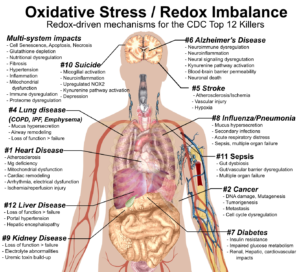

Explaining the Redox Health Proposition to Google Gemini
By Michael R Sherer
Distilling the Future of Health
You’ve probably seen this before: E = mc² It’s one of the most famous equations in the world. And even if you’re a little fuzzy on what it means, you know it matters. It’s Einstein’s way of condensing the physics of the universe—and the atomic bomb—into five keystrokes.
That kind of clarity is powerful. And in 2020, I wondered: Could we do the same for health?
At the time, I was deep in the research for what would become my first book, “One Disease: Redox Imbalance.” My Aha! Moment came while reading a landmark paper by Helmut Sies and Dean P. Jones defining the ‘Redox Code.’ Buried within their framework was an idea so audacious, so biologically fundamental, that redox imbalance was architecturally involved in all disease. It wasn’t just a factor; it seemed central. Grappling with the implications of that single concept became the core effort behind the book. From that early attempt to unpack and explain it, a seven-word thesis emerged: ‘Stress causes disease. Redox Imbalance is why.'”
Like the Redox Code that inspired them, those seven words are audacious! As an author and researcher, I’m claiming that:
- Stress—broadly defined—is the root cause of nearly all disease. In fact, I have yet to find a disease where the pathology of that disease isn’t significantly tied to redox-driven damage and dysregulation—even genetic diseases like Down Syndrome and Sickle Cell Anemia.
- Redox imbalance, a disruption in the body’s ability to balance oxidants and reductants (basically, electron traffic at the cellular level) is the fundamental process that accelerates aging and leads to symptoms and disease.
Now, five years and four books later, that seven-word core has grown into a 20-word model I call the Redox Health Proposition (RHP):
“Stress causes disease. Redox Imbalance is why. Stress Resilience prevents disease. Addressing root causes reverses disease. Exposomics enables Precision Health.”
I firmly believe these are the 20 most consequential words in modern health science. Bold? Sure. But when you follow the logic and the evidence, they point toward a new foundation for prevention, precision health, and real healing. It’s the basis of a preventative model of healthcare that I want for my own health, and for my friends and family.
To see if I could explain this paradigm clearly, I brought it to one of the most advanced reasoning tools on the planet: Google Gemini Pro 2.5. This model lets you peek into its thought process—what it accepts, what it rejects, and what it’s unsure about.
The result was a kind of philosophical sparring session. At first, Gemini did what most smart skeptics would do: raised some red flags. “Isn’t this an oversimplification?” “What about genetics?” “Inflammation?” But the more I explained, the more the model began to see the system. Here’s how that conversation went—starting with the foundation.
1. Stress Causes Disease: It’s NOT all in your head.
When I asserted that “Stress causes disease,” Gemini’s ‘Show Thinking’ response was squarely in the common but limited view of stress – psychosocial pressure. You’ll encounter this frequently in both Western medicine, mainstream health journalism, and the general public. My first clarification, the first ‘Explanatory Principle’ (EP) needed, was broadening the definition:
🧠 EP 1.1: Broad Definition of Stress: Stress isn’t just mental; it’s any demand (physical, chemical, biological, environmental, pathogenic, psychosocial, genetic/epigenetic, drugs, internal systemic dysfunction, even lack of good stress) requiring bodily adaptation. (See Hans Selye’s General Adaptation Syndrome).
In other words, it’s not just deadlines or traffic jams. It’s mold exposure, junk food, chronic sleep loss, loneliness, early-life trauma, chronic stress, and even oxidative shifts from pollution. Every one of these counts as “stress”—because each demands a biological adjustment. Next, we needed to establish how stress responses work and accumulate:
⚖️ EP 1.2: Predictable Response Patterns: Your body and cells are obligated to respond to stress of any kind. These responses are autonomous, meaning you don’t consciously think about them. They’re also individual, meaning the responses will vary between people and even for the same person at different times and circumstances, but they’ll follow predictable patterns. These typically involve activation of central stress response (the HPA axis), the autonomic nervous system (e.g., sympathetic nervous system), the immune system, and the cellular stress response (e.g., antioxidant defenses, heat shock proteins, unfolded protein response).
🤕 EP 1.3: Predictable Symptom Patterns: Similarly, the resulting disease symptoms often manifest in predictable patterns (like fatigue, malaise, cognitive changes, altered mood) largely driven by the ‘oxy-inflammatory’ state arising from the stress response. (See research into sickness behavior and critical illness behavior).
🧳 EP 1.4: Cumulative Stress Burden: Chronic disease results from a lifetime of cumulative stress exposures (see Exposomics), stress adaptations and maladaptations, and resulting damage and dysregulation at a cellular and systemic level. (See also Allostasis/Allostatic Overload).
That stress bucket metaphor resonated. Imagine your body as a container. Each stressor—small or large—adds water. A little is fine. But if it keeps coming (cumulative burden), and your adaptive systems struggle (maladaptation), eventually it spills over (exceeding capacity). And when it does? That’s when systems break down, often manifesting first via common symptom patterns before progressing to diagnosable disease. By the time we reached this point, Gemini started to track the idea that stress isn’t just a feeling—it’s a core operating principle in human physiology.
2. Redox Imbalance is Why: Beyond Oxidative Stress and Damage
When I presented the second principle, Gemini was skeptical again, primarily seeing redox imbalance through the common lens of oxidative stress causing cellular damage. Hence the questions: “Why just redox imbalance? What about inflammation? Genetics?” This required layering several explanatory principles:
🔄 EP 2.1: The Core Mediator of Stress Adaptation: Redox Systems mediate the body’s adaptive response to diverse stressors. Thus, Redox Imbalance, in epidemiological terms, is the necessary (inherent in the stress response) but insufficient (needs other stressors) cause of all disease. (Even genetic ones, like Down Syndrome, have massive redox components).
⚠️ EP 2.2: Includes Oxidative & Reductive Stress: Redox Imbalance includes both oxidative stress (too much oxidation) AND reductive stress (too much reduction). It’s not just ‘oxidants bad, antioxidants good.’ Balance is key.
💡 EP 2.3: Dual Consequences (Damage & Dysregulation): Redox Imbalance causes both direct molecular damage(oxidation/“rust”) AND critical dysregulation of redox signaling (garbled cell communication). This signaling aspect is vital.
🛠️ EP 2.4: The Centrality of Signaling: Physiological redox signaling is local, transient, and purposeful (adaptive). Pathological states involve widespread, uncontrolled, or non-specific redox disruption leading to damage and dysregulation of cells, tissues and organ systems. (Example: superoxide disrupting Nitric Oxide signaling AND forming toxic peroxynitrite that damages the circulatory system).
চক্র EP 2.5: Self-Perpetuating Disease Loops: Redox imbalance often initiates or fuels vicious cycles (e.g., inflammation ↔ oxidative stress feedback, mitochondrial damage ↔ ROS loops). These loops make disease states self-sustaining, causing them to persist or worsen over time.
⏳ EP 2.6: Accelerates Aging: Sustained Redox Imbalance is a primary driver of biological aging, accelerating the oxi-inflammatory damage and dysregulation that underlies cellular and systemic decline.
🌐 EP 2.7: Universality in Disease: Because redox imbalance is inherent in significant stress responses triggered by any disruption of homeostasis, it is mechanistically involved in essentially all disease states.
Once Gemini accepted redox imbalance not just as damage but as a dynamic, stress adaptation system – its assessment shifted. Redox systems involve fundamental communication, energy-transfer, and regulatory system that become universally dysregulated under significant stress load – initiating damage, disrupting signals, fueling vicious cycles, and driving aging. It wasn’t the only factor involved in disease, but its role as the core mediator became clear. These EPs align redox imbalance with current understandings in Redox Biology and disease pathology.
3. Stress Resilience Prevents Disease: Benefiting from Stress and Recovery
This principle can be confounded by the popular understanding of resilience as psychological or mental toughness (“grit”). Gemini initially showed signs of this viewpoint. I needed to establish the broader, physiological basis:
🧹 EP 3.1: Physiological Capacity: Resilience is a measurable physiological capacity (involving efficient energy metabolism, balanced immunity, robust antioxidant defenses, nutritional sufficiency, etc.) built through adaptive responses to eustress (good stress/hormesis) plus adequate recovery. (It’s not just mental grit).
⚖️ EP 3.2: Dynamic & Multifaceted: Stress Resilience is a dynamic state that can be lost, maintained, or bolstered over time and involves mental, intellectual, physical, and potentially social components.
❌ EP 3.3: Resilience < > Reactivity: The opposite of resilience is reactivity – characterized by flares, exaggerated symptom intensity, and overreactions to everyday triggers, central to many health concerns.
🔺 EP 3.4: Balance Equation: Your health depends on whether your eustress activities (Resilience Habits) + recovery capacity consistently outweighs your total stress burden (allostatic load). (Think ‘Scales of Justice’).
🧐 EP 3.5: Knowledge Component: Knowledge is part of resilience. While frequently undervalued, knowing how to intervene effectively (self-care, resilience habits, finding aligned practitioners, seeking help) dramatically enhances adaptive capacity.
Framing resilience as this active, physiological balancing act – where beneficial ‘eustress’ and adequate recovery must consistently outweigh the total stress burden (like on those ‘Scales of Justice’ in EP 3.4) – provided the necessary context lacking in simpler notions of ‘grit’. Once Gemini processed resilience not just as a passive trait but as this dynamic, measurable capacity (EP 3.1, 3.2) whose opposite is the harmful state of reactivity (EP 3.3), the third principle clicked into place. It became clear how consciously cultivating this multifaceted resilience, informed by understanding our own balance (EP 3.5), serves as a fundamental, proactive strategy to prevent bodily systems from tipping into disease.
4. Addressing Root Causes Reverses Disease
On first blush, the key critique of the fourth principle is over-reach. Everyone knows someone who was ‘too far gone’ and all you could do was manage symptoms and provide palliative care. The key assertion is that the RHP is an early intervention paradigm. Because we know that redox stress and associated inflammation are key drivers of accelerated aging, systemic dysregulation and chronic disease, we can intervene and address them early, IF we’re paying attention! Explanatory principles need to emphasize the body’s innate capacity to heal, and the need to unblock healing by addressing root causes.
⛏️ EP 4.1: Defining and Understanding Root Causes: “‘Root causes’ are the specific underlying stressors and imbalances driving the disease. Removing these ‘blocks’ – which often involve self-perpetuating disease loops (see EP 2.5) sustained by recurring or chronic stressors – unleashes innate healing mechanisms.” The current challenge is that we don’t know what all the stressors are, and we do insufficient testing to understand even the known stressors.
⏳ EP 4.2: Early Intervention is Key: The RHP is inherently an early intervention paradigm. Addressing root causes early maximizes the potential for restoring function and achieving reversal/remission before irreversible damage occurs; the goal is maintaining and restoring function, not just symptom management.
So, does addressing root causes always reverse disease, as skeptics (and initially, Gemini) might rightly question? Of course not, especially if things are ‘too far gone.’ But by clarifying that the RHP is designed as an early intervention strategy – getting those ‘rocks’ (EP 4.1) out of the stream before the whole landscape erodes – the principle becomes clear. It’s about enabling the body’s own repair crew (innate healing) while it still has a chance to fix things properly (EP 4.2). Seen that way, it’s not over-reach; it’s strategic, early action aimed at restoring function.
5. Exposomics enables Precision Health: The Personalized Future
The fifth principle can trigger concerns that Exposomics has no discernible footprint in clinical medicine, largely because it’s still a relatively new field. Let’s be clear, none of these ideas have had measurable impact on Western medicine. Yet. They should, and that’s the purpose behind making the RHP in the first place. There’s also a growing acceptance that Exposomics is the future of preventative health and precision therapeutics, underpinning the broader goals of Precision Health. Despite its relative immaturity, we already can see that Exposomics combined with Metabolomics is surfacing unknown stressors that are key drivers of certain diseases.
🧰 EP 5.1: Exposome Definition: The “Exposome” encompasses the totality of exposures from conception onwards, including external factors (diet, environment, lifestyle) and the resulting internal biological responses and environment (metabolites, signals, stressors), reflecting cumulative stress exposures.
🌱 EP 5.2: The State of Exposomics: While Exposomics as a discipline has momentum, it’s also relatively immature due to complexity. Nevertheless, findings from Exposomics and related ‘omic’ studies are currently yielding actionable insights into disease prevention, pathology, and therapeutics, a flow expected to accelerate rapidly.
⏱️ EP 5.3: Timing Matters: Exposure impact is influenced by timing, with developmentally sensitive periods (early life) being particularly consequential. (Examples: understanding biological impacts of ACEs, nutritional influences in utero like folate/neural tube defects).
🌐 EP 5.4: Precision & Epidemiology: Exposomics, by surfacing hidden/unknown stressors (internal/external), provides the individual data necessary for Precision Prevention/Health and the collective data that unlocks the epidemiology of disease and aging.
🌟 EP 5.5: Transgenerational Context: An individual’s initial biological state and resilience at conception are shaped not only by genetics but also by parental exposures and inherited epigenetic patterns, highlighting the potential for transgenerational impacts of the exposome.
With this broader, more dynamic understanding – viewing the Exposome as the sum of lifetime stressors, internal and external (EP 5.1), recognizing critical windows of vulnerability (EP 5.3) and even acknowledging potential generational legacies (EP 5.5) – its integral role within the RHP became undeniable. Gemini acknowledged that Exposomics, especially its power to surface previously hidden or unknown stressors (EP 5.4) and provide actionable insights even now (EP 5.2), provides the essential methodology required. It’s the key to finally quantifying the diverse array of ‘Stress’ that drives disease (Principle 1) and pinpointing the specific ‘Root Causes’ (Principle 4) needed for the truly personalized prevention and care promised by Principle 5: Precision Health.
The “Aha!” Moment (For AI—and Us)
Gemini wasn’t swayed by a single fact, but by the internal consistency, logic, and explanatory power of these five interconnected principles. Together, they form a system—explaining how diverse stressors, through redox pathways can cause damage and dysregulation but also stress resilience and healing. It’s a new, more scientifically accurate paradigm that points towards a future where healthcare is personalized, and root-cause-based approaches prevent disease before it occurs.
Why Does This Matter?
This isn’t just philosophy. The RHP:
- Makes sense of why so many diseases share common pathways
- Highlights the central, underappreciated role of redox balance
- Focuses on resilience-building and root causes, not just symptoms
- Points toward precision health, not just protocol-driven sickcare
Key Takeaways:
- Stress isn’t just psychological. It’s any demand requiring adaptation.
- Redox balance is central. Disruption drives both damage and dysregulation.
- Resilience is physiological. Build it to prevent breakdown.
- Address root causes early. Unblock healing before it’s too late.
- Exposomics is the future. Quantify exposures to drive prevention.
A Word to the Skeptics
Paradigms shift slowly. Not everyone will be convinced today—and that’s okay. But if you’re tired of managing symptoms and want to understand “why,” the Redox Health Proposition offers a new map for the journey: one rooted in balance, resilience, and truly personal prevention.
What stressors are filling your ‘bucket’? What resilience habits tip your balance toward health? Let’s build a smarter, saner, more resilient model of health—together.
For Further Reading
1. Allostasis and Allostatic Load:
- McEwen BS. Stress, adaptation, and disease: Allostasis and allostatic load. Annals of the New York Academy of Sciences. 1998;840:33-44.
- Note: This is a landmark paper formally defining allostatic load and its link to disease.
- Sterling P, Eyer J. Allostasis: a new paradigm to explain arousal pathology. In: Fisher S, Reason J, eds. Handbook of Life Stress, Cognition and Health. John Wiley & Sons; 1988:629-649.
- Note: Where Peter Sterling originally coined the term “allostasis.”
- McEwen BS, Wingfield JC. The concept of allostasis in biology and biomedicine. Hormones and Behavior.2003;43(1):2-15.
- Note: An influential review expanding on the concept.
2. The Redox Code (Associated with Dr. Dean P. Jones):
- Jones DP. Redefining oxidative stress. Antioxidants & Redox Signaling. 2006;8(9-10):1865-1879.
- Note: Argues for moving beyond just damage to understand redox state as a regulatory system.
- Jones DP, Sies H. The redox code. Antioxidants & Redox Signaling. 2015;23(9):734-735.
- Note: An editorial introducing the specific term and concept, emphasizing redox potentials (like GSH/GSSG) as key regulators.
- Go YM, Jones DP. The redox code. Redox Biology: Oxidative Stress and Dietary Antioxidants. Springer; 2022:15-34.
- Note: A book chapter providing a more recent overview of the concept. (Or other comprehensive reviews/book chapters by Jones on this topic).
3. General Adaptation Syndrome (GAS) & Selye on Stress:
- Selye H. A syndrome produced by diverse nocuous agents. Nature. 1936;138:32.
- Note: The very brief, original report outlining the GAS.
- Selye H. The Stress of Life. McGraw-Hill; 1956 (Revised edition 1976).
- Note: Selye’s seminal book explaining his stress concept in detail.
- Selye H. Stress without distress. Psychopathology of human adaptation. Springer; 1976:137-146.
- Note: Discusses the important distinction between eustress and distress.
4. The Redox Theory of Aging:
- Harman D. Aging: a theory based on free radical and radiation chemistry. Journal of Gerontology.1956;11(3):298-300.
- Note: The foundational paper for the Free Radical Theory of Aging, the precursor concept.
- Go YM, Jones DP. Redox theory of aging. Biochimica et Biophysica Acta (BBA)-General Subjects. 2017;1861(1 Pt B):370-378. (Note: Also listed under Redox Code, shows the overlap).
- Note: Specifically discusses aging through the lens of redox state potential shifts.
- López-Otín C, Blasco MA, Partridge L, Serrano M, Kroemer G. The hallmarks of aging. Cell.2013;153(6):1194-1217. (Updated version: López-Otín C, et al. Cell. 2023;186(2):243-278.)
- Note: While not solely focused on redox, this landmark review integrates mitochondrial dysfunction, inflammation, and deregulated nutrient sensing (all redox-linked) as core hallmarks.
5. Hormesis:
- Calabrese EJ, Baldwin LA. Defining hormesis. Human & Experimental Toxicology. 2002;21(2):91-97.
- Note: A key paper formally defining the concept in toxicology and biology.
- Calabrese EJ, Mattson MP. How does hormesis impact biology, toxicology, and medicine? NPJ Aging and Mechanisms of Disease. 2017;3:13.
- Note: A review by two leading proponents discussing broad implications.
- Mattson MP. Hormesis defined. Ageing Research Reviews. 2008;7(1):1-7.
- Note: Provides perspective on hormesis, particularly linking it to adaptive stress responses relevant to exercise and diet.
Exposomics:
- Wild CP. Complementing the genome with an “exposome”: the outstanding challenge of environmental exposure measurement in molecular epidemiology. Cancer Epidemiology Biomarkers & Prevention.2005;14(8):1847-1850.
- Note: The seminal paper where Christopher Wild coined the term “exposome.”
- Wild CP. The exposome: from concept to utility. International Journal of Epidemiology. 2012;41(1):24-32.
- Note: A follow-up reflecting on the development and potential application of the concept.
- Rappaport SM, Smith MT. Environment and disease risks. Science. 2010;330(6003):460-461.
- Note: Influential perspective connecting environmental exposures comprehensively to disease risk, central to exposomic thinking.
- Miller GW, Jones DP. The nature of nurture: refining the definition of the exposome. Toxicological Sciences.2014;137(1):1-2.
- Note: Discusses the concept, including internal and external factors, linking environment (“nurture”) to biology.
- Vermeulen R, Schymanski EL, Barabási AL, Miller GW. The exposome and health: Where chemistry meets biology. Science. 2020;367(6476):392-396.
- Note: A high-profile, more recent review highlighting the interdisciplinary nature and potential of exposomics.
Metabolomics (Especially in Exposome Context & Scale):
- Nicholson JK, Lindon JC, Holmes E. ‘Metabonomics’: understanding the metabolic responses of living systems to pathophysiological stimuli. Xenobiotica. 1999;29(11):1181-1189.
- Note: A foundational paper defining the field and its application in understanding biological responses to stimuli (like exposures).
- Rappaport SM. Implications of the exposome for environmental chemical regulation. Proceedings of the National Academy of Sciences USA. 2011;108(44):E964; author reply E965. (Also see related Rappaport works linking blood concentrations to exposome).
- Note: Directly links the exposome concept to the measurable internal chemical environment, a key target of metabolomics.
- Patti GJ, Yanes O, Siuzdak G. Innovation: Metabolomics: the apogee of the omics trilogy. Nature Reviews Molecular Cell Biology. 2012;13(4):263-269.
- Note: Positions metabolomics within the ‘omics’ landscape and discusses its scope and potential. The concept of the vast number of metabolites (“million metabolite metabolome” reflects this scope) arises from the sheer chemical diversity detected by advanced mass spectrometry, often discussed in reviews or perspectives from leaders like Siuzdak assessing the scale of the challenge and opportunity.
Michael R Sherer is the author of the Redox Health Series, an innovative collection of health books seeking to translate cutting edge science on disease, aging and prevention into actionable form for general audiences. The series current includes:
- One Disease: Redox Imbalance. How stress becomes disease.
- Resilience! The Key to Lifelong Health
- My AI Diabetes Coach
- Recipes for Resilient Eating
Each book builds on and Redox Health Proposition, a 20-word distillation of current medical science. Its five big ideas form a compelling foundation for a preventive health paradigm that moves us closer to the promise of personalized or Precision Medicine.
Sherer is a member of the Society for Redox Biology and Medicine and the American Society for Nutrition, and Mennonite Healthcare Fellowship.